How Engineering Firms Can Use Their Website to Win Better Projects
Most engineering firm websites are not working very hard.
They exist. They list the services the firm provides. They show some projects. They have a contact page. And they sit there, doing essentially nothing to help the firm win work, attract talent, or differentiate itself in a competitive market.
This is not because engineering firms do not have compelling stories to tell. Most do. They have deep technical expertise, strong client relationships, a track record of solving genuinely difficult problems, and a portfolio that would impress any serious evaluator. The problem is that the website is not built to communicate any of that effectively.
The result is a digital presence that functions like a placeholder — something to hand people who already know you, rather than a tool that actively supports business development with people who do not.
That gap is closeable. And for engineering firms competing in markets where the right clients are doing real due diligence before making contact, closing it matters more than most principals expect.
Why Engineering Firms Tend to Underinvest in Their Websites
The skepticism engineering principals have toward web presence investment is understandable and not entirely wrong. A lot of marketing and web design work done for engineering firms is surface-level. It produces a nicer-looking version of the same undifferentiated site without addressing the underlying issues — unclear positioning, weak project presentation, no search visibility, content that speaks to engineers rather than to the clients making hiring decisions.
When those investments do not move the needle, it reinforces the belief that the website does not matter. That the work speaks for itself. That clients come through referrals and relationships and the website is just background noise.
There is truth in that for early-stage firms. Referrals and relationships are the foundation of most engineering firm growth and no one is suggesting otherwise. But they have a ceiling. And as firms grow, pursue more selective work, enter new sectors, or try to attract candidates who do not already know them, the website stops being background noise and starts being a meaningful factor in the firm's ability to compete.
What a Well-Built Engineering Firm Website Actually Does
The firms that have invested thoughtfully in their web presence — and seen it pay off — are using their websites to do specific, concrete things for their business development. Not generating leads in the way a consumer brand generates leads, but doing the quieter work of building credibility, supporting evaluation, and removing friction from the process of a serious prospect deciding to reach out.
Here is what that looks like in practice.
It creates a strong first impression before any conversation starts. When a project owner, developer, or public agency is building a shortlist, they look at websites. The quality and clarity of your digital presence is one of the first signals they use to assess whether your firm is serious. A polished, well-organized site that communicates your expertise clearly moves you onto the shortlist. A generic or disorganized one removes you before the conversation starts.
It supports the evaluation process for sophisticated clients. Engineering firm clients do structured due diligence. They want to see sector experience, project scale, delivery methodology, key personnel, and relevant credentials. A website that organizes this information clearly — rather than burying it in a project gallery or a PDF download — makes their evaluation process easier and makes your firm the easier choice.
It extends your reputation into markets where you are not yet known. Referrals work inside the networks you already have. A website works everywhere else. Firms that want to grow into new sectors, new geographies, or new client types need a digital presence that can introduce them credibly to audiences that have never encountered the firm before.
It works for recruiting as well as client development. Strong candidates evaluate firms before they apply. An engineering firm website that communicates a clear culture, a compelling body of work, and a sense of where the firm is headed attracts a different caliber of candidate than one that looks generic or stagnant.
The Four Things Most Engineering Firm Websites Get Wrong
Understanding what is holding your current site back is a useful starting point before thinking about what to fix.
Wrong thing one: Leading with services instead of positioning. A list of disciplines — structural, civil, mechanical, geotechnical — tells a visitor what the firm does. It does not tell them why this firm is the right choice for their specific project. In a market where every competitor has a similar service list, undifferentiated positioning is the same as no positioning. The website should answer "why us" before it answers "what we do."
Wrong thing two: Project presentation that does not support evaluation. Photos with project names and locations. That is what most engineering firm project pages contain. It is not enough for a client doing real evaluation. They want to know the project scope and scale, the delivery method, the client type, the specific technical challenge and how it was solved, and the outcome. That level of detail transforms a portfolio from a visual archive into an evaluation tool.
Wrong thing three: Writing for engineers instead of for clients. Engineering content tends to use internal language and assume technical context that non-specialist decision-makers do not share. The person initiating the procurement process is often not a technical expert. The website has to speak to both audiences — specific enough to be credible to the technical evaluator, accessible enough to be persuasive to the decision-maker who is not an engineer.
Wrong thing four: No search visibility. Engineering firms that want to be found by clients who do not already know them need a website with the keyword structure, heading architecture, and content depth that search engines require to understand and surface the site. Most engineering firm websites have none of this. They are invisible to search and invisible to the AI-driven search tools that are increasingly shaping how professional services firms are discovered.
Where to Start if Your Engineering Firm Website Is Not Working
The most common instinct when an engineering firm decides to address its website is to start with design — find a web designer, look at templates, pick a direction. That instinct leads to most of the disappointing results engineering firms have had with previous web investments.
The right starting point is positioning. Before any design decision is made, you need clarity on three things: who this website is for, what it needs to communicate to that audience, and what you want a visitor to do when they land on it. Those answers shape every design and content decision that follows. Without them, even a beautifully designed site does not work.
For engineering firms with clear positioning who are ready to move into a website project, the sequence that consistently produces the best results is: site architecture first, design in a prototyping tool before any development begins, copywriting developed alongside design rather than after it, and SEO structure built in from the start rather than added at the end.
That process takes longer than starting with a template and swapping in your logo. It produces a fundamentally different result.
What This Looks Like for an Engineering Firm in Practice
The Stor Kran project is a useful reference point, even though Stor Kran is a marine construction equipment company rather than a traditional engineering firm. The challenge they faced — establishing credibility with technically sophisticated clients in a market where they had no established presence — is one that engineering firms navigating new sectors or new geographies face regularly.
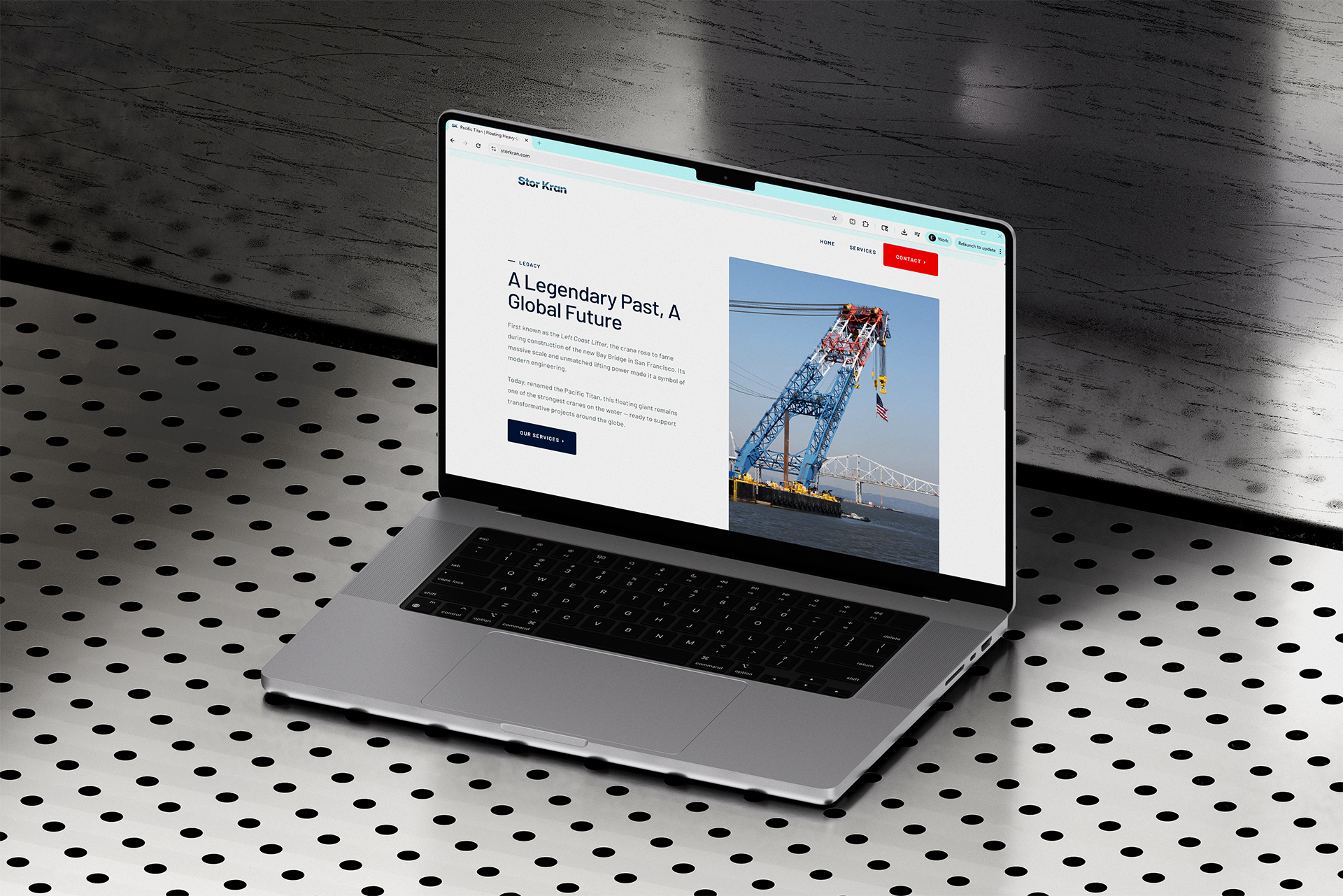
The website we built was not a portfolio site. It was a structured credibility and evaluation resource, designed around the specific things the firm's target clients needed to see and assess before initiating contact. The technical specifications were organized for easy reference. The scale of the equipment was communicated through photography and visual treatment before copy. The inquiry path was short and frictionless.
The result was a site that did real work from day one — supporting the firm's business development in a market where first impressions and immediate credibility are everything.
That is what engineering firm web design looks like when it is built around what the site actually needs to accomplish.
The Honest Bottom Line
If your engineering firm's website is not helping you win better projects, it is probably not because websites do not matter for engineering firms. It is because the site was not built to do that job.
The firms that have figured this out are not doing anything exotic. They have clear positioning on their homepage. Their projects are presented with enough depth for serious evaluation. Their team section builds personal credibility. Their site is findable by the clients looking for exactly what they offer. And someone on the team can update it when a new project wraps or a new person joins.
That is not a high bar. For most engineering firms, it is just not the site they currently have.
See our engineering web design work
Learn about engineering firm branding